
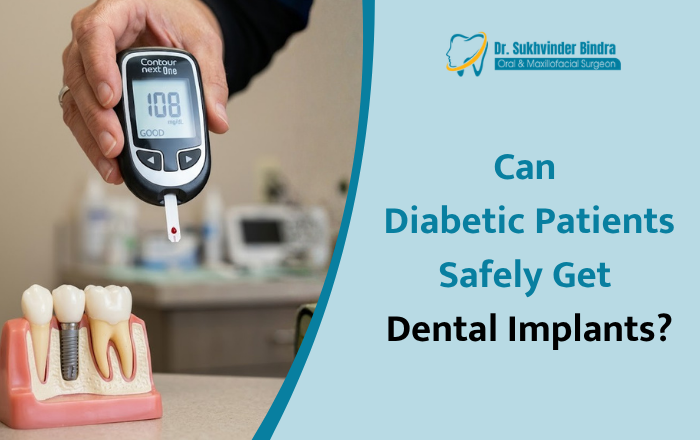
If you have diabetes and you’re missing one or more teeth, you’ve probably asked yourself this question. The idea of going through surgery while managing blood sugar levels can feel overwhelming even scary. But here’s something most people don’t know: diabetes does not automatically disqualify you from getting dental implants. In fact, with the right preparation and a skilled surgeon by your side, dental implants for diabetic patients can be just as successful as they are for anyone else. Let’s break it all down in simple terms. Why Do Diabetics Often Need Dental Implants? Here’s an uncomfortable truth people with diabetes are significantly more likely to lose teeth than those without it. According to the American Diabetes Association, diabetics are 2 to 3 times more likely to develop gum disease, which is one of the leading causes of tooth loss. High blood sugar damages the blood vessels that feed your gums and bone. Over time, this weakens the foundation holding your teeth in place. So the very condition that raises questions about implant safety is also the one making implants necessary for so many patients. So, Can Diabetics Actually Get Dental Implants? Yes — and the research backs this up. Studies show that dental implants in diabetic patients with well-controlled blood sugar have a success rate of 94–97%, which is very close to the success rate seen in non-diabetic patients. The key factor isn’t whether you have diabetes it’s how well your diabetes is managed. Patients with an HbA1c level below 7–8% are generally considered good candidates for implant surgery. If your levels are higher, your doctor may ask you to stabilize them before moving forward. What Are the Real Risks for Diabetic Patients? Being informed is important. Here are the main risks — and how they’re handled: 1. Slower Healing High blood sugar slows the body’s natural healing process. After implant surgery, the implant needs to fuse with your jawbone — a process called osseointegration. In diabetics, this may take a little longer, and your surgeon will monitor it closely. 2. Higher Infection Risk Diabetes can weaken your immune system. Your surgeon will likely prescribe antibiotics before and after surgery to keep infection risk low. 3. Gum Disease Must Be Treated First If you have active gum disease, it must be fully treated before any implant is placed. Skipping this step is one of the top reasons implants fail. 4. Bone Healing In poorly controlled diabetes, the bone around the implant may heal slowly. This is why blood sugar control before surgery is not optional it’s essential. 5 Signs You May Be Ready for Dental Implants You could be a strong candidate for dental implants with diabetes if: ✅ Your HbA1c is below 8% and has been stable for at least 3 months ✅ You have no active gum disease, or it has been treated ✅ You have enough jawbone density ✅ You are a non-smoker, or willing to stop before surgery ✅ Your physician and oral surgeon are working together on your care How to Prepare — Step by Step Step 1 — Get a full medical check-up Share your HbA1c levels, current medications, and medical history with your surgeon. Step 2 — Control your blood sugar Your target HbA1c should be below 7–8% before surgery is scheduled. Step 3 — Treat gum disease first Healthy gums are the foundation for a successful implant. Step 4 — Follow antibiotic and medication guidance Your surgeon will guide you on what to take before and after the procedure. Step 5 — Be patient with healing Your healing timeline may be slightly longer. That’s completely normal and manageable. Implants vs. Dentures — Which Is Better for Diabetics? Many diabetics are simply handed dentures without being told there’s a better option. Here’s a quick comparison: Dental Implants Dentures Bone preservation ✅ Yes ❌ No Stability ✅ Fixed, permanent Slips and shifts Hygiene Easier to maintain Traps bacteria underneath Long-term cost Lower over time Needs regular replacement For diabetic patients with controlled blood sugar, implants often give far better long-term results — both for oral health and day-to-day comfort. Quick Tips to Make Your Implant Last Monitor your blood sugar before and after surgery Brush twice daily and floss regularly Quit smoking — it doubles implant failure risk Visit your dentist every 3 to 6 months Never skip your diabetes medications Recommended Specialist in Secunderabad If you’re in Secunderabad and wondering whether dental implants are safe for you as a diabetic patient, the best thing you can do is speak to someone with real experience in handling medically complex cases. We recommend consulting Dr. Sukhvinder Bindra, an Oral and Maxillofacial Surgeon with 20+ years of experience in dental implant treatment. Dr. Bindra understands the careful planning that diabetic patients need — from blood sugar evaluation to post-surgical monitoring — and takes every step to make sure your implant journey is as smooth and safe as possible. Book your consultation with Dr. Sukhvinder Bindra today and find out if dental implants are the right choice for you. FAQs Q1. Can Type 2 diabetics get dental implants? Yes. Most Type 2 diabetics can get implants if their HbA1c is below 8% and gum disease is treated first. Q2. What HbA1c level is safe for dental implants? Most surgeons recommend an HbA1c of 7–8% or below before proceeding. Q3. Do implants take longer to heal in diabetics? They can, but well-controlled diabetics usually heal close to normal timelines. Q4. Will I feel pain during the procedure? The surgery is done under local anesthesia, so you won’t feel pain. Post-surgery discomfort is manageable with prescribed medication. Q5. Can uncontrolled diabetes cause implant failure? Yes. High blood sugar significantly raises the risk of infection and implant failure.
