
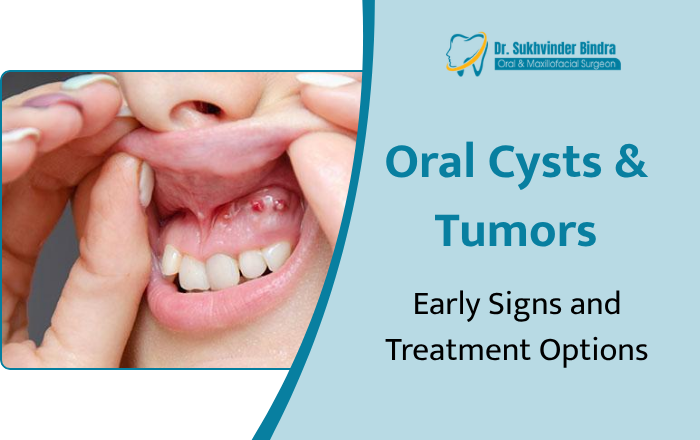
Have you ever run your tongue across the inside of your mouth and felt something unusual — a small bump, a swelling, or a lump that wasn’t there before? It can be unsettling, especially when you don’t know what it is. The good news is that most oral cysts and tumors are not life-threatening. But here’s the thing — some of them can become serious if left untreated for too long. The sooner you understand what you’re dealing with, the better your chances of a smooth recovery. This blog will walk you through everything you need to know about oral cysts and tumors, from the first warning signs to the treatment options available today. What Are Oral Cysts and Tumors? Let’s start simple. An oral cyst is a small, fluid-filled sac that forms inside the mouth, jaw, or surrounding tissue. Think of it like a tiny balloon filled with liquid. It grows slowly and is often painless, which is exactly why so many people don’t notice it early. An oral tumor, on the other hand, is a solid tissue growth. Tumors can be benign (non-cancerous) or malignant (cancerous). Just because something is called a “tumor” doesn’t automatically mean cancer — many are completely harmless. That said, both cysts and tumors deserve proper attention, because without a diagnosis, you simply cannot know what you’re dealing with. 7 Early Warning Signs You Should Never Ignore Your body gives signals. The problem is, early signs of oral cysts and tumors are easy to brush off. Here’s what to watch for: A painless lump inside your cheek, gums, or jaw that stays for more than two weeks Swelling around the face or jaw that doesn’t seem to go down Loose teeth without any obvious dental cause Numbness or tingling in the jaw or lower lip area Difficulty opening your mouth, chewing, or swallowing White or red patches on your tongue, inner cheeks, or gums Persistent bad breath or an unusual taste that doesn’t go away despite good oral hygiene If any of these sound familiar, don’t brush it off. These are your body’s way of asking for attention. Common Types of Oral Cysts Not all oral cysts are the same. Here are the most common types: Dentigerous cysts form around unerupted or impacted teeth — most often wisdom teeth. They are the second most common type of jaw cyst and can grow quite large if not caught early. Radicular cysts develop at the root of a tooth, usually as a result of a long-standing infection or untreated tooth decay. These are actually the most common oral cyst type overall. Odontogenic keratocysts are less common but more aggressive. They have a recurrence rate of 25–60% after removal, making proper surgical treatment and follow-up critical. Mucoceles are soft, fluid-filled bumps that appear on the inner lip or cheek, often after accidental biting. They look alarming but are generally harmless — though they do tend to come back. How Are Oral Tumors Diagnosed? When you visit an oral and maxillofacial surgeon for a lump or swelling, they’ll start with a thorough clinical examination. From there, imaging tests like an OPG (dental X-ray), CT scan, or MRI may be used to get a clearer picture of what’s happening beneath the surface. If the growth looks suspicious, a biopsy where a small sample of tissue is sent to a lab is the most reliable way to determine whether something is benign or malignant. This is the gold standard of oral tumor diagnosis, and it removes all guesswork. India reports over 77,000 new oral cancer cases every year, many of which are diagnosed at a late stage simply because people waited too long. When caught at Stage I or II, the five-year survival rate is above 80%. That number drops significantly with a late diagnosis. Early action genuinely saves lives. Treatment Options for Oral Cysts and Tumors Oral cyst treatment depends on the type, size, and location of the growth. Here’s what your surgeon might recommend: Surgical removal (excision) is the most common approach. The cyst or tumor is removed under local or general anesthesia. Most patients return to normal within 5–10 days. Marsupialization is used for larger cysts, especially in the jaw. Rather than removing the entire cyst at once, the surgeon creates a small opening to drain it gradually — reducing pressure on surrounding bone and nerves. Monitoring may be appropriate for very small, stable growths. Your surgeon will schedule regular check-ups and imaging to make sure nothing changes. For larger oral tumors that affect the jaw bone or surrounding tissue, reconstructive surgery may also be needed to restore normal function and appearance. Can Oral Cysts Come Back? Yes, some can. Odontogenic keratocysts, in particular, have a high recurrence rate. This is why follow-up care after oral cyst surgery is just as important as the procedure itself. Regular imaging and check-ups help catch any regrowth before it becomes a bigger problem. Time to Get the Answers You Deserve If you’ve noticed a lump, swelling, or any of the signs mentioned above, please don’t wait. Dr. Sukhvinder Bindra, a trusted Oral and Maxillofacial Surgeon for oral cyst surgery in Secunderabad, has helped many patients get the right diagnosis and the right care — before small problems become serious ones. Reach out to his clinic today and take the first step toward peace of mind.
